I have had a few thoughts banging around in the dusty attic of my brain recently but none seemed worthy of a full post, so I figured why not offer a bit of beer potpourri? Below are my thoughts on a few items that have been in the news lately.
A Shift in Brewery Closures?
The first couple months of 2026 have seen the continuation of the depressing trend of brewery closures across Canada. What caught my eye, in particular, is some of the names of those closing. Lighthouse Brewing, Paddock Wood Brewing, 2 Crows Brewing, Kichesippi Brewing. All are well-established, well-respected breweries on the relatively larger end of craft breweries in Canada. All had distribution outside their home province. Three had been open for more than 15 years (2 Crows had been open 9). Paddock Wood was a pioneer in Saskatchewan craft brewing, and Lighthouse has been a bastion of the BC scene for decades.
Discerning patterns in brewery closures is a complex business. But as I scan my database, something about these recent announcements feels different. In recent years closures have been more common among younger and smaller breweries. These are breweries that never met their initial goals, or failed to establish a reliable market niche. Often they are under-capitalized from the start and a wave of increased input costs swamp them. They cannot build up sufficient cash flow to weather bad times and/or lack the resources to expand or increase efficiencies to become more sustainable.
None of that really applies to the four breweries here. All had well-established brands and solid reputations for quality product. All, as far as I can tell, had loyal followings and seemed reliably anchored in the market. Of course, I don’t know the details of their inner workings and so can’t fully know the reasons, and without question the dynamics are quite unique for each. But it remains curious that four mature breweries made the decision to shutter (yes, some have merged with other breweries, but they still cease to exist as an independent entity).
I think this speaks to the depth of the crisis in craft beer. The impact of reduced consumption, higher input costs and changing consumer habits is no longer nibbling at the edges of the industry, impacting the smaller and relatively weaker players. For the past couple years every (and I mean EVERY) brewery I have spoken with expresses grave concerns about the state of the industry and (sometimes vaguely) talks of their own struggles.
This tells me we are on the cusp of an industry re-structuring. Five years from now the industry will look very different than today. Fewer breweries overall with a narrower range of business models that prove successful. These four breweries may be something of a canary in the coalmine – an early warning that danger lies ahead. I hope I am wrong, but I have a bad feeling about it.
Free Trade in Beer – Or Not
Over the past couple months we have seen provinces announce signing of direct-to-consumer (DTC) sales agreements, allowing individuals to purchase alcohol directly from a brewery across provincial borders. These announcements are follow-ups from the memorandum of understanding between the federal government and 10 provincial governments to expand “free trade” in alcohol. The MOU, which has a deadline of May 2026 for implementation, seeks to guarantee consumers can purchase alcohol across provinces.
Sounds great, no?
No. It is all window dressing, at least for beer. The key is that the arrangement applies only to sales to individuals. The MOU clearly states that it “does not include sales by or to wholesalers, retailers, or other licensees”. So, in effect the MOU and subsequent provincial bilateral agreements allow me to go online and order a case of my favourite whatever to be shipped to me directly by the producer. It does not increase selection at my local liquor store, restaurant or bar.
Maybe for wine and spirits this free-flow of DTC sales might be beneficial. I can certainly see an oenophile ordering a case of a rare BC wine to ship to their home in New Brunswick, or a scotch aficionado seeking out a rare aged-whiskey from a small distiller in rural Quebec. But this simply isn’t practical for beer. Most beer does not travel well, and who will want to pay the shipping costs for a four-pack of a hazy IPA from Nova Scotia or witbier from Manitoba (think about the condition that beer will be in by the time it reaches you)? I can see maybe a rare release of an imperial stout or barley wine peaking a beer geek’s interest but effectively what percentage of a brewery’s revenue will that amount to? One-tenth of one percent (if i am being generous). Simply not worth the hassle of setting up a shipping infrastructure.
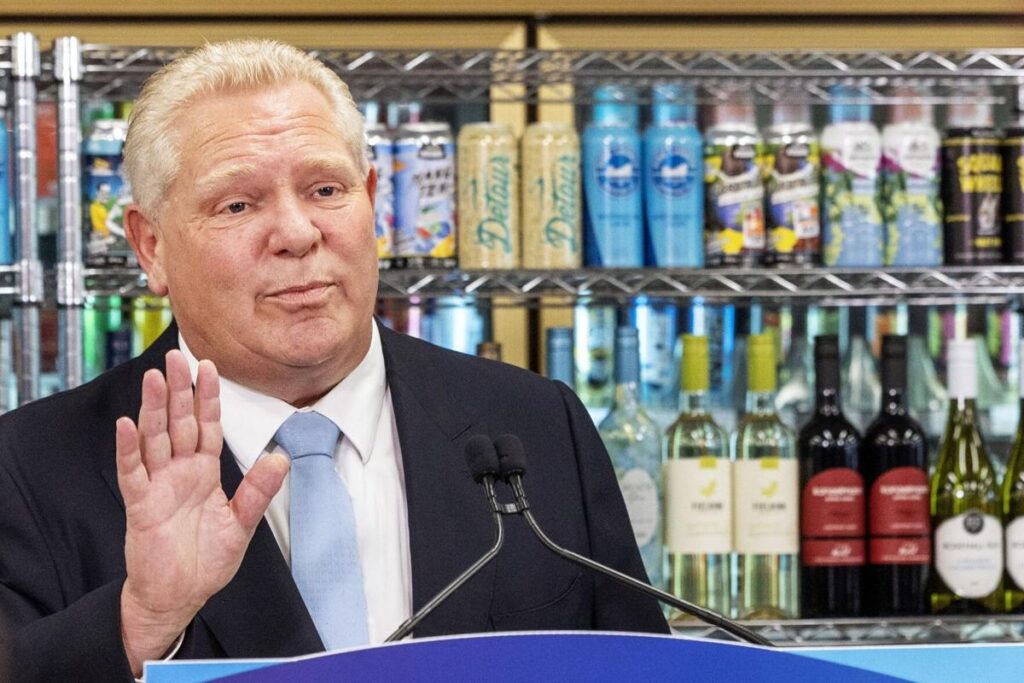
Free trade in beer will not be a real thing until the various barriers, hurdles and discouragements erected by liquor control boards across the country are removed. Only once provinces start agreeing to eliminate their quotas, preferential policies and tasting panels, will I think they are being serious about the whole business. Until now it just gives Doug Ford and friends a photo-op in front of a shelf of beer.
What is “Alberta” Whisky?

At the end of March, the Alberta government introduced legislation (Bill 24: Alberta Whisky Act) to create an official designation of “Alberta Whisky”. Now, whisky is not my beat but I still have some thoughts on the matter since it drifts into alcohol policy, which is definitely my wheelhouse.
According to the bill, a distiller can label a spirit Alberta Whisky if it meets the following conditions:
- Meets the standards for Canadian Whisky under the federal Food and Drug Regulations
- Production takes place entirely in Alberta
- At least 2/3 of the weight of the cereal grain is grown in Alberta
- Water is sourced in Alberta
- Not blended or modified other than with flavouring, water, or caramel
- Meets other (unspecified) requirements in regulation
To sum up: it must be Canadian Whisky made in Alberta with Alberta ingredients. That is what it basically boils down to.
Forgive me, why does this require a designation? With all respect to the good folks of the Alberta Craft Distillers Association (who are supporting the move), this legislation – at best – makes no sense.
Hear me out. Elsewhere, designations for particular alcoholic products are anchored in both region and history. Champagne, Port, Scotch and Bourbon are all designations designed to protect a unique historical tradition for a region. The geography is important – the designation requires that the product be made in that region – but it cannot be separated from history. The product is intertwined with the cultural self-image of the people who live there, or at least those that are immersed in that portion of their culture.
We see this in the main whisky derivations. Scotch, Irish, and Bourbon all have an intermixing of geography, history and culture (and, in some cases, ingredients and process) that give heft and meaning to the designations. The designation means something because it stands upon hundreds of years of tradition. (Keep in mind I am not an expert, so won’t attempt to delve into the historical details of these traditions.)
Of course we also have Canadian Whisky, which stands on much more dubious cultural ground, but there is a legitimate claim that the product is distinct from other Whiskys (although the regulations do not recognize that) and we do have some real history to our distilling industry. I am just not sure your uncle’s devotion to Crown Royal is really the equivalent to Highlands Scotch in terms of cultural significance.
If we start considering Alberta whisky, then even the historical and, one could argue, geographic elements fall apart. We have had distillers since the province was founded, but for decades they have been just branch plants of the large global distilling industry. There is not much to point to in their process or pedigree that speaks to an Alberta-specific history. Our craft distilling industry are recent newcomers, the oldest being less than 15 years old. I respect their determination and skills and strongly believe many are making world-quality spirits, but they are unquestioningly newcomers to the scene.
But the barley, you say! Yes, Alberta produces some of the best malting barley in the world. That is something to be immensely proud of. But is it enough to lay a stake on an official regional designation? Our immediate neighbours to the east also make fantastic barley. And let’s not forget the Canadian (and thus Alberta) designation does not specify the type of grain. Are we really going to plant our whisky flag on our corn? It just doesn’t add up.
I understand that the craft distillers see this as a potential marketing advantage, something to hook consumers with and improve the profile of our whisky. Fair enough. I just think it only works as a marketing tool if it has some authenticity behind it. Consumers aren’t dumb. The hardworking men and women making whisky in Alberta are most definitely authentic, but they can sell that without a schlocky faux-designation.
If am charitable I would say that this is just a gimmicky publicity stunt for the Premier to look cool with a dram of whisky in her hand. In less charitable moments, I am inclined to think this is just a part of the UCP’s ongoing proto-separatist drive, attempting to elevate Alberta above all (Uber Alles???). The UCP is working very hard to erase our Canadian reality and replace it with a faux-Alberta primacy. I am worried whisky is becoming an unwitting accomplice in this dubious project.
Besides, what is wrong with calling the spirits we create here Canadian Whisky? It is perfectly usable branding (even if its origins are a bit sketchy) and it more accurately reflects the culture and history in which our whisky tradition was created. It is something Alberta distillers could hang their cowboy hat on quite easily.

April 10, 2026 at 3:51 PM
As always – insightful. Vancouver Island Brewing and Sleeping Giant – two more well-tenured breweries – could also make the list. VIB has dedicated commercial brewing operations to Phillips down the street (who will also produce Lighthouse), and have held onto a small pilot system to develop future recipes; Sleeping Giant, down East in Thunder Bay, was meant to close the end of last month but might have new investors to keep the steam coming out of the kettle; but as you’ve noted – it’s sobering to see well-established brewers struggling, and certainly means the landscape will change. Craft went through something similar in the late 90’s – different pressures were on the category then – but what will be different here is the regulatory landscape is more flexible now than it was back then. I’m hoping that will give some brewers a soft landing (like Beau’s accomplished).